A social robot doesn't need to understand every human feeling to be useful. It needs to hear a request, notice who is speaking, wait its turn, and respond in a way that fits the task. The progress is coming from tighter jobs, better sensors, and clearer limits.
- Speech systems can separate commands from background noise.
- Cameras can track faces, body position, and where someone is looking.
- Good interaction still depends on knowing when to stop, ask, or hand control back.
What the robot has to notice
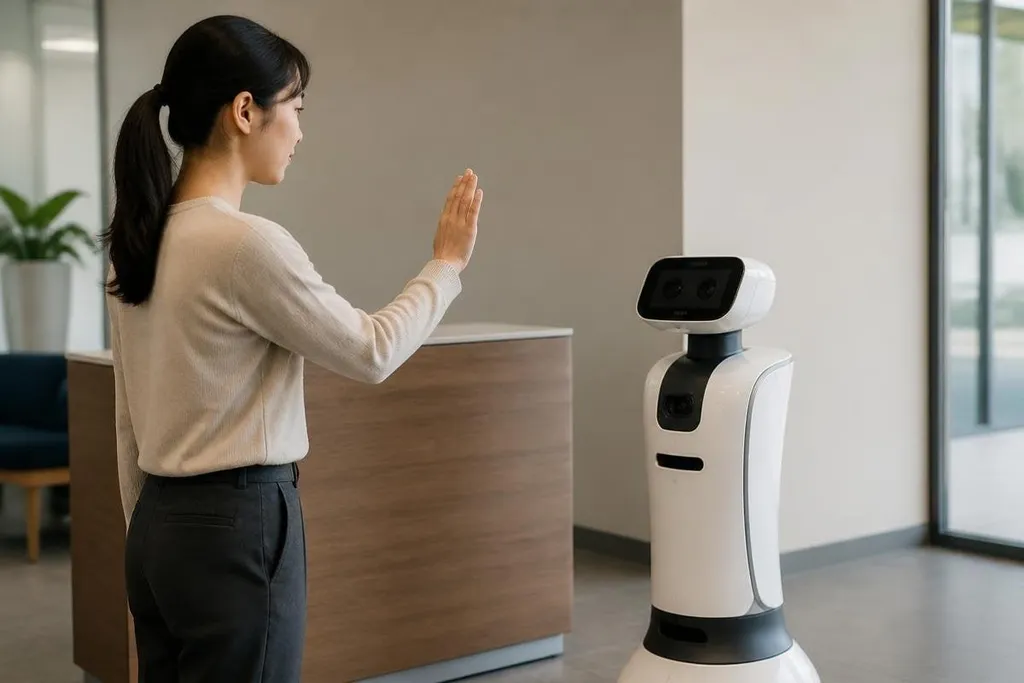
Social interaction starts before the robot speaks. A person may face the robot, raise a hand, point toward an object, or pause after asking a question. It has to combine those signals with spoken words before it chooses a response.
Most systems use microphones for speech and cameras for faces, hands, and body position. Some also use depth sensors, which measure how far objects are from the robot. That extra distance data helps separate a nearby speaker from the rest of a room.
The hard part is timing. If the robot answers while someone is still talking, the exchange feels broken even when the words are correct. A useful system watches for pauses, changes in voice, and signs that the speaker has finished.
Narrow tasks make better results possible
A robot working at a reception desk has a smaller social job than a household robot moving through a busy home. It may need to greet a visitor, ask for a name, give directions, and call a staff member.
Each task can be tested against a clear result. That limit matters because human conversation changes with place and purpose.
A hospital guide needs different rules from a classroom robot. The guide may need to repeat directions and protect private information, while the classroom robot may need to take turns among several children.
Robot makers can also set safe responses for situations the system can't read. It might ask the person to repeat a request, call a human worker, or stop moving when speech and body signals disagree. Those choices are less dramatic than a free-form conversation, but they are easier to check.
Memory changes the feel of a conversation
A robot that remembers the last request can avoid asking the same question twice. Short-term memory may be enough for a shopping list, a lesson, or a service call. Longer memory raises harder questions about consent, storage, and who can view the record.
The word “memory” can describe several different systems. A robot may keep a few recent messages, store a user preference, or search a database for a past record. Those systems have different risks, so a product should say which kind it uses.
A response can also sound polite while being wrong. The robot may repeat a person's name correctly and still misunderstand the request. Social skill needs a clear handoff when the system lacks enough information.
That handoff is where a social claim meets a real test: did the robot ask for clarification, stop, or pass control to a person? A dated Robot24 report can tie that behavior to a named robot and setting before the next section examines what still fails.
What still fails
People use tone, shared knowledge, and small changes in expression to judge a conversation. Robots can measure some signals, but a measurement isn't the same as understanding. A smile may show agreement, discomfort, or politeness depending on the setting.
Noise creates another problem. Several people speaking at once can confuse speech recognition, while poor lighting can affect face and hand tracking. A robot may work well in a quiet test room and need a human nearby in a busy public space.
Privacy also affects trust. Cameras and microphones can record more than the task requires, especially when the robot waits in a room for a wake word. Clear indicators, local processing where possible, and a physical way to disable sensors give people more control.
A buyer's check before deployment
Use these questions before putting a social robot near customers, patients, students, or staff:
- Name the task: Write the exact requests the robot must handle.
- Test the room: Check speech, lighting, distance, and crowd noise at the planned site.
- Set the handoff: Decide when a person takes over and how the robot signals that change.
- Check memory: Find out what data the robot stores, for how long, and who can access it.
- Measure failure: Record missed turns, wrong replies, and false calls for help.
I'd judge a social robot by its recovery after a mistake, not by a smooth greeting. A system that admits uncertainty and calls a person can be more useful than one that keeps talking.
The next useful measure is narrow and practical: how often the robot completes its assigned exchange without interrupting, guessing, or needing a human to repair the conversation.